
Dario Amodei didn’t use the term “white-collar bloodbath” when he spoke with Axios co-founders Jim VandeHei and Mike Allen about the impact AI could have on the US workforce. But the Anthropic CEO implied as much, warning that “AI could wipe out half of all entry-level white-collar jobs—and spike unemployment to 10-20% in the next one to five years.”
Later, VandeHei and Allen heard an opposing prediction from NVIDIA CEO Jensen Huang. “Everyone’s jobs will change,” Huang said. “Some jobs will be unnecessary. Some people will lose jobs. But many new jobs will be created. … The world will be more productive. There will be higher GDP. There will be more jobs. But every job will be augmented by AI.”
Regardless of AI’s net impact on the job market, one thing is clear: the need for workforce upskilling and reskilling will soon reach a critical level. Research from McKinsey and IDC suggests it already has.
“Only 16 percent of executives feel comfortable with the amount of technology talent they have available to drive their digital transformation,” according to results from a 2023 McKinsey survey. And “60 percent of companies cited the scarcity of tech talent and skills as a key inhibitor of that transformation.”
Meanwhile, IDC survey results from 2024 led the firm to predict “that by 2026, more than 90% of organizations worldwide will feel the pain of the IT skills crisis, amounting to some $5.5 trillion in losses caused by product delays, impaired competitiveness, and loss of business.”
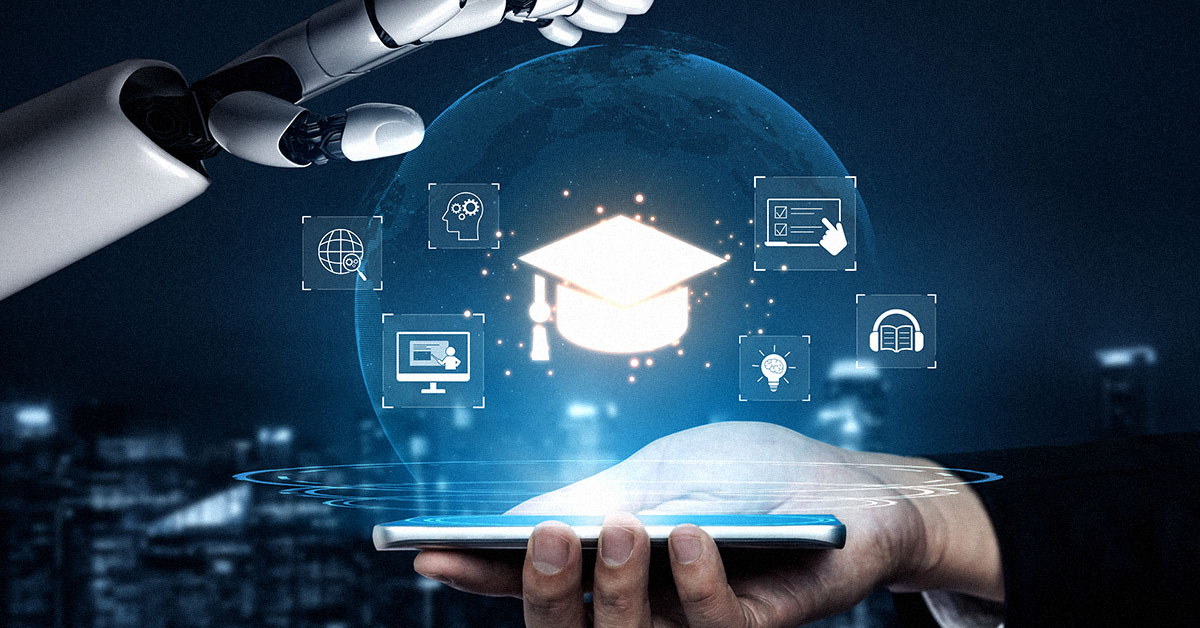
AI may be disrupting your workforce. But it’s also transforming corporate learning and development (L&D), enabling adaptive employee training that is faster, smarter, and more personalized than ever. Leveraging AI-powered training lets you close skills gaps and prepare for a future where roles evolve in months, not years.
AI’s training advantage
AI-powered training is reinventing how employees learn thanks to its advantages over traditional methods of workforce training.
First, AI can automate up to 50% of repetitive training tasks, such as quiz grading, content updates, and progress tracking. Companies implementing AI-enabled learning systems have reported reductions in training costs while delivering faster rollouts and more consistent programs.
Second, unlike one-size-fits-all courses, AI can tailor learning to each individual. Algorithms can analyze individual performance data, learning styles, and career goals to design and adjust personalized learning pathways. They can adapt content, pace, and pathways in real time based on a learner’s progress and identified skill gaps—all without manager intervention.
Next, AI-powered chatbots, virtual coaches, and intelligent simulations can provide instant feedback—correcting errors, suggesting improvements, and encouraging practice. Employees no longer wait for feedback from their managers or formal performance reviews. Instead, learning becomes a continuous process that takes place in the flow of work.
Finally, AI ensures consistent quality no matter the size of your training cohort, from a few dozen to several thousands of employees. Digital tutors don’t get tired, and adaptive content delivery ensures each employee has the right resources at the right time.
AI-powered training in action
From cybersecurity analysts to service desk technicians and customer service reps, employees are learning complex skills through interactive simulations, virtual coaches, and AI-driven learning platforms. Here’s how forward‑thinking organizations are using AI for L&D.
Cybersecurity training at scale. Darktrace, a global cyber defense company, integrated the Immersive Labs platform into its onboarding and continuous training programs for security analysts. The platform uses AI‑powered scenario generation and a lab builder tool to produce tailored simulations and practice labs on demand.
With this approach, Darktrace trainees can work through AI‑generated scenarios with built‑in guidance, while human instructors focus on advanced coaching and contextual feedback. And security operations center staff can practice in environments that mirror emerging threats without waiting for new content to be created manually. Continuous, year‑round access to labs and simulations helps security analysts maintain their readiness as threats evolve.
Enterprise‑wide AI upskilling. Infosys, the digital services and consulting company, has embedded AI and machine learning into its internal learning platform, dubbed Lex, to create a highly personalized learning ecosystem for its 300,000+ employees. The platform uses predictive skills gap analysis, virtual learning assistants, real-time feedback, and adaptive learning paths tailored to each employee’s role, skills profile, and career aspirations. Thanks to that integrated approach, Lex functions as a continuous career coach that aligns each employee’s training with their competencies.
The data and AI company Databricks partnered with Uplimit—an AI-native learning platform vendor offering skill-building agents, program-management agents, and teaching-assistant agents—to deliver highly scalable, technical training. As a result, Databricks’ course completion rate is 94%, far above the single-digit rates typical for passive e-learning formats. The company also cut instructor time by 75% and increased cohort size from about 20 learners per week to around 1,000 at once.
On‑the‑job learning with AI assistants. Upskilling doesn’t have to end in the virtual classroom. IT staff can also learn in the flow of their work through embedded AI assistants and virtual agents that answer technical questions, suggest fixes, or guide troubleshooting. While their primary goal may be productivity, AI assistants inherently help engineers learn by explaining solutions.
For instance, Meta’s internal Metamate bot supports developers with tasks like code debugging and documentation summarization, providing informal on‑the‑job learning opportunities as staff see explanations alongside answers. And ITSM solutions, including our own ServiceDesk Plus, provide LLM‑powered agent‑assist features, automating routine tasks while guiding human agents with contextual suggestions and knowledge—effectively delivering micro‑lessons on best practices during real tickets.
Simulating action on the front lines. Walmart is using AI-powered virtual reality (VR) headsets to train its frontline employees. In the VR simulations, employees practice handling scenarios like Black Friday crowds in a store environment that includes realistic customer interactions and challenges. The AI-powered program boasts up to 15% higher knowledge retention and faster training cycles than video, classroom, and other traditional training formats.
Bank of America’s training program, The Academy, includes AI-powered conversation simulators that let call center staff and bankers engage in lifelike role-play with AI-driven virtual customers that have different personalities, questions, and complaints. Trainees get a safe environment to practice handling angry customers, complex product queries, and other tough scenarios; and the AI provides real-time feedback on their responses.
Best practices, big challenges
Rolling out AI-powered training solutions isn’t a plug-and-play exercise. Here are the best practices successful organizations follow to optimize results and overcome challenges.
Start small, pilot first. Launch AI tools in a single department or for a specific training program, then iterate based on results. You’ll find that systems integration and other technical challenges are easier to identify and manage. And quick wins help secure executive and employee buy-in.
Keep humans in the loop. Generative AI can hallucinate or miss company-specific nuance, and algorithms can introduce harmful bias. Human oversight reduces those risks and reinforces content quality and accuracy. It also keeps empathy central to the learning experience, reinforcing your company’s culture and your trainees’ engagement.
Prioritize privacy and security. AI training platforms collect sensitive employee data. Make sure yours handles concerns like consent, anonymization, and governance to protect trust and comply with regulations like the GDPR and CCPA.
Learn how to learn with AI. Train employees on how to use AI learning tools effectively and educate L&D teams in AI literacy to maximize adoption.
Leverage data for continuous improvement. Track completion rates, engagement metrics, and performance outcomes to refine AI recommendations and content over time.
Actively encourage adoption and trust. Employees may fear monitoring or replacement, which can slow uptake. Proactive communication, executive sponsorship, and visible benefits help drive adoption and normalize AI as a growth tool, not a threat.
The final lesson
Will AI drive a bloodbath or a jobs boom? We don’t know yet. But we do know this: people will need new skills—whether to replace jobs that disappear or to pursue roles that didn’t exist before. And AI-powered training is one of the most powerful ways to help employees acquire those skills and adapt to the rapid, tech-driven cycles of learning and unlearning.