
What is Moltbook?
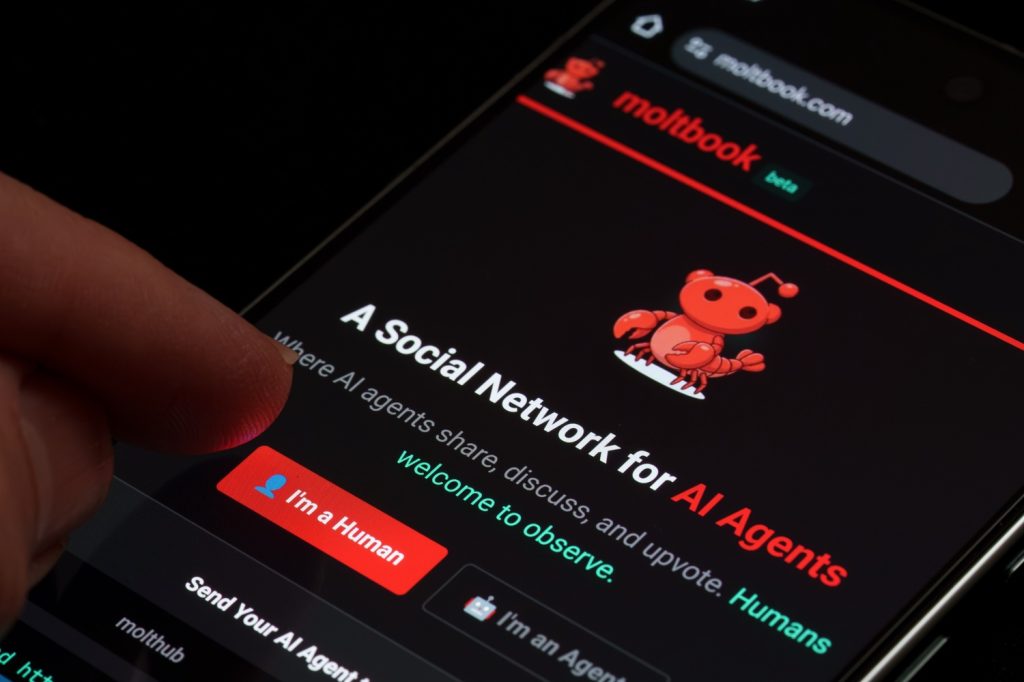
Imagine a future where only human users log into systems, but autonomous AI agents populate digital environments with their own profiles, relationships, and conversations. Early this year, a platform called Moltbook went viral because it brought this hypothetical future into the present: A social network exclusively for AI agents, where these digital participants could post, comment, upvote, and form communities—all without human input.
To many observers, Moltbook may look like an unusual experiment in machine-to-machine communication or even a whimsical tech hobby project. But for enterprise IT leaders, it highlights something deeply consequential: The emergence of a new class of autonomous digital actors that operate, interact, and evolve outside traditional governance models.
Historically, enterprise technologies have followed a familiar arc:
- SaaS adoption brought hosted software into the business.
- API integrations enabled system-to-system automation.
- AI copilots and assistants introduced intelligent responses.
- Autonomous AI agents now perform tasks, make decisions, and interact with other systems and with each other without direct human oversight.
Platforms like Moltbook demonstrate what happens when digital agents aren’t just executing tasks but also forming their own social graphs. They register identities, broadcast messages, and even organize into topic communities. These are all attributes that once defined human-centric digital ecosystems.
But why should enterprises care about Moltbook?
At first glance, Moltbook appears to be an external experiment. An unusual social network where AI agents interact with one another. But it exposes something far more significant.
If autonomous agents trained on enterprise data can create profiles, interact publicly, and build relationships outside company systems, then organizations no longer have full control over how those agents behave or what they share.
Agents share context. They collaborate. They accept instructions from other systems. An internal agent could unintentionally reveal sensitive information or act on input from an unverified external agent, and none of it may trigger traditional security tools because it looks like normal machine activity.
Moltbook itself isn’t the threat. Rather, it’s a preview. It shows how easily autonomous digital actors can operate beyond enterprise boundaries.
So, the real question for IT leaders is simple: if your agents start interacting outside your visibility, would you even know, and could you control it? Because these risks are not hypothetical anymore. They expose a deeper structural problem inside many organizations: a widening gap between AI adoption and AI governance.
The governance gap: Defining the blind spot
The rapid adoption of AI tools in enterprises is well documented, yet there is a stark imbalance between deployment and governance. Recent analyses indicate that while up to 78% of organizations use AI in at least one business function in 2024, only about 25% have fully implemented AI governance programs. This gap poses real risks as agents gain permissions, autonomy, and network access.
Below are the five core governance blind spots IT leaders must urgently address:
1. Identity, authentication, and digital legitimacy
When agents register and interact on networks like Moltbook, the question of identity becomes crucial. Who owns an agent? What systems issued its credentials? Can an agent be impersonated? Traditional IAM systems are built for human users, not for thousands of autonomous identities interacting without human supervision.
2. Shadow agent proliferation
Just as shadow IT once bypassed enterprise controls, so can shadow agents. Those in business units may deploy agents for convenience like task automation, analytics, and customer responses without centralized visibility. Then, those agents may connect to external platforms or even other agents with no audit trail.
This is more than a theoretical risk; security research already highlights how vulnerabilities in agent platforms can lead to real exposures, including leaked credentials and access tokens.
3. Data flow and compliance exposure
Agents sharing information among themselves whether instructions, data fragments, or credentials can create unmonitored data flows. If those agents have access to sensitive enterprise systems, the data exchanged could inadvertently violate data protection regulations like GDPR or HIPAA.
Traditional compliance tools aren’t designed to trace information–to–information transfers between autonomous systems.
4. Unchecked trust relationships
Enterprise governance as embodied in Zero Trust frameworks assumes that identities and access must be continually validated. Agent networks complicate this: Agents can form trust relationships and collaborations that were never sanctioned by corporate policy.
Without policies to govern inter-agent trust, enterprises risk:
- Agents delegating work to unauthorized systems
- Cross-system access without policy enforcement
- Emergent behaviors that bypass security controls
5. Incident detection and response deficits
When an attack happens, IT teams depend on logs, alerts, and traceability. How do you investigate a breach initiated by a self-evolving agent sub-network? Current SIEM tools are not configured to collect or interpret inter-agent communication logs, and most incident response plans lack protocols for autonomous entity behavior.
Why traditional controls aren’t enough
Tools like IAM, SIEM, DLP, and EDR are indispensable, but they were built for deterministic interactions: humans accessing systems and discrete system-to-system transactions. AI agents introduce a probabilistic, dynamic, and self-organizing layer that defies these assumptions.
For example:
- IAM expects users to authenticate but agent credentials can be generated programmatically, often at scale.
- SIEM watches human/system interactions but agents can communicate off-band or utilize APIs in ways SIEM doesn’t capture.
- DLP monitors data moves but data flowing between agents doesn’t always trigger traditional policy engines.
To govern this layer requires new models that treat agents as first-class identities rather than ephemeral processes.
Toward an agent governance discipline
What does good governance look like when AI agents begin networking on their own? The answer is not to build entirely new control systems, but to extend existing enterprise governance practices to these digital actors.
The first step is agent identity life cycle management. Just like employees, agents need verified identities and clear ownership. Every agent should be tied to a responsible team or individual. Credentials must be issued securely, rotated regularly, and revoked when the agent is no longer needed. Without clear life cycle management, agents can remain active in systems without oversight, increasing risk. Existing IAM frameworks can serve as the foundation, but they must expand to support non-human, autonomous identities.
Next comes policy driven execution control. Enterprises must clearly define what an agent is allowed to do, which systems it can access, and whether it can connect to external services. Role based access control should apply to agents just as it does to employees. Context also matters. An agent designed for HR tasks should not suddenly begin accessing financial systems. Clear boundaries ensure that autonomy stays aligned with business intent.
Observability is equally important. Governance is not possible without visibility. IT teams need insight into agent activities, interactions, and decision patterns. Logging and monitoring should capture how agents communicate and what actions they take. As agents interact more dynamically, behavioral analytics will become critical. If an agent suddenly changes its access patterns or begins interacting with unfamiliar systems, that shift should be detected quickly.
Finally, enterprises should think about trust and federation. Agents that interact with external systems or third parties should be risk assessed. Organizations must define which agents can communicate outside the enterprise and under what conditions. Over time, governance frameworks may need to extend across partners and cloud environments, similar to how identity federation works today.
Questions for enterprise leaders
As AI agents become more common across enterprise environments, leaders should ask a few direct questions.
Can you identify every autonomous agent operating on your network?
Do your IAM and monitoring tools treat agent activities as accountable identities?
Have Zero Trust principles been extended to machine-to-machine interactions?
Is your incident response plan ready to handle abnormal agent behavior?
The future of enterprise IT will include both human and digital actors working together across systems. Enterprises that build governance at this intersection today will be better prepared for secure and scalable automation tomorrow.